
Occupational Therapy Driving Assessments & Car Modifications on the Sunshine Coast & Gympie
Fitness-to-drive assessments, vehicle modifications, and driver support, led by a qualified driving assessor.
On Track Rehab provides occupational therapy driving assessment on the Sunshine Coast, in Gympie, and across the surrounding regions. Driving is central to independence, work, and community life, and a medical condition, injury, disability, or the passing of time can all raise questions about safe driving. Our driving services are led by Marnie, a qualified driving assessor and occupational therapist, who provides thorough, supportive assessments and car modification advice to help you keep driving safely for as long as possible — or to return to driving when you’re ready. Our goal is always to support your safety and your independence.
Occupational therapy driving assessment on the Sunshine Coast & Gympie
An occupational therapy driving assessment is a specialised evaluation of your ability to drive safely. Unlike a standard driving test, it considers how your health, vision, thinking, and physical function affect driving, and whether vehicle modifications, adaptive equipment, or further training could help. The assessment is evidence-based and aligned with the national Assessing Fitness to Drive standards, giving you, your doctor, and the licensing authority clear, objective information to support the right decision about your licence.
Our driving assessment services
As a qualified driving assessor, Marnie provides a full range of occupational therapy driving services, including:
- Occupational therapy driving assessments — evaluating your fitness to drive after a medical condition, injury, or disability.
- Car & vehicle modification assessments — assessing, trialling, and prescribing adaptive driving equipment and modifications.
- Senior driving assessments — supporting older drivers and their families with reassurance about ongoing safe driving.
- Readiness to drive (learner) assessments — for new and learner drivers with a disability or medical condition.
Why you might need a driving assessment
People are referred for an occupational therapy driving assessment for many reasons, including:
- Returning to driving after a stroke, brain injury, spinal cord injury, or other medical event.
- A new or progressing medical condition that may affect driving (such as a neurological or movement disorder).
- A physical disability or injury where vehicle modifications may be needed to drive safely.
- A referral from a GP, specialist, or the licensing authority to confirm fitness to drive.
- A senior driving assessment, where you or your family want reassurance about ongoing safe driving.
- A readiness to drive (learner) assessment when learning to drive with a disability or medical condition.
The Driving Assessment Journey
Step 1: Doctors / Specialist Clearance
Before your driving assessment, we ask you to get clearance from your GP or specialist. This confirms you’re medically stable and safe to take part, gives us the background we need to make your assessment meaningful, and keeps everything in line with the national Assessing Fitness to Drive standards. In Queensland, you’re also legally required to notify the Department of Transport and Main Roads of any long-term condition that may affect your driving — and your doctor’s clearance is the right way to start. It protects you and keeps the process on track.
Step 2: Referral
Once you have medical clearance, a referral is sent to On Track Rehab — this can come from your GP, specialist, support coordinator, or insurer, or you can enquire with us directly. The referral gives us your relevant medical history, your goals, and any conditions affecting your driving. We then contact you to confirm the details, explain costs and funding, answer your questions, and book your assessment. If the licensing authority has requested the assessment, we make sure the referral covers what they need.
Step 3: Off-road (clinical) assessment
In a comfortable, off-road setting, Marnie reviews your medical history and assesses the underlying skills that driving relies on — including vision, physical function (strength, movement, coordination, and reaction time), and cognitive and perceptual skills such as attention, judgement, and processing. This helps identify any areas that may affect driving and what supports might help.
Step 4: On-road (practical) assessment
Where appropriate, an on-road assessment is conducted in a dual-control vehicle together with a qualified driving instructor, in real traffic conditions. This shows how your skills come together in practice, and whether vehicle modifications or additional training would help you drive safely. If you need modified controls, these can be trialled as part of the assessment.
Step 5: Car & vehicle modification assessment and prescription
For many people, the right vehicle modifications make safe, independent driving possible. As part of, or following, your driving assessment, Marnie can assess for, trial, and prescribe modifications and adaptive driving equipment, and prepare the reports funders require. These may include:
- Hand controls for acceleration and braking.
- Left-foot accelerators and pedal modifications or guards.
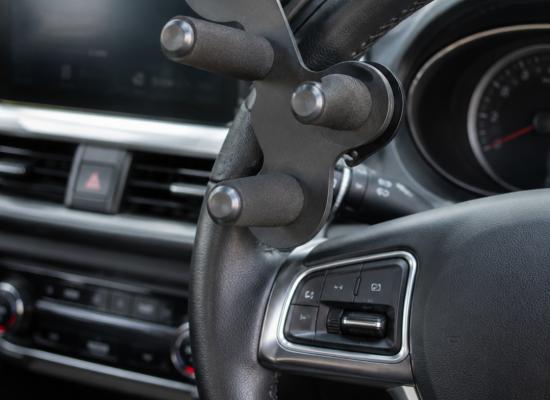
- Steering aids such as spinner knobs and other grips.
- Secondary control adaptations (indicators, lights, and other functions).
- Modified or specialised seating, and transfer aids.
- Wheelchair access, hoists, and stowage solutions for getting your wheelchair or scooter in and out.
- Modifications to support safe access as a passenger, where required.
We trial options where possible, specify exactly what’s needed, and work with qualified vehicle modifiers to ensure modifications are appropriate, safe, and correctly fitted — then support you to learn to use them confidently.
Step 6: Driver training & rehabilitation (mediation)
If the assessment shows that further training would help — for example, after a medical event or when learning to use new vehicle modifications — we can guide a program of driver rehabilitation, delivered with a qualified driving instructor. This builds the skills and confidence you need to drive safely and, where relevant, to meet the conditions of your licence.
Step 7: Outcomes & reports
After your assessment, your occupational therapist provides clear recommendations and a written report. Depending on your situation, the outcome may be that you are safe to continue driving, safe to drive with vehicle modifications or licence conditions, would benefit from further training before a decision, or — in some cases — that it is safest to stop driving. We discuss the results with you honestly and supportively, and we can provide reports to the licensing authority and to funders to support modifications, training, or alternative transport options.
A collaborative, joined-up approach
Safe driving outcomes depend on teamwork. With your permission, we collaborate closely with your GP and medical specialists, qualified driving instructors, vehicle modifiers, the licensing authority, support coordinators, plan managers, families, and carers. By coordinating the right people around your goals, we help you achieve the safest, most independent outcome possible.
Further information & support
For trusted information on fitness to drive, licensing, and occupational therapy, these sources are a great place to start. For further information, visit:
- National medical standards for driving — Austroads — Assessing Fitness to Drive (austroads.gov.au)
- Queensland licensing & medical fitness to drive — Queensland Government — Medical fitness to drive (qld.gov.au)
- About occupational therapy (peak body) — Occupational Therapy Australia (otaus.com.au)
What to expect — information for new participants
Questions about driving can feel stressful, but you don’t have to face them alone. We approach every assessment with honesty, respect, and a focus on your safety and independence. Here’s how we work:
- Supportive and clear: we explain the process, what we’re assessing, and why, in everyday language.
- Thorough and objective: we use recognised standards so the outcome is fair and evidence-based.
- Practical solutions: where modifications or training can help you keep driving safely, we’ll find them.
- Honest outcomes: if it’s safest to stop or pause driving, we’ll discuss this sensitively and help you plan alternatives.
- Funding support: we prepare the reports funders and the licensing authority require, and keep you updated.
Our aim is simple: to support your safety on the road and your independence in everyday life.
For support coordinators, case managers, GPs & fellow clinicians
Need an experienced occupational therapy driving assessment for your client or patient? On Track Rehab makes the process simple, responsive, and collaborative. We provide mobile occupational therapy across the Sunshine Coast, Gympie, and surrounding regions, and we work as an extension of your client’s care team. When you refer to us, you can expect:
- Assessments conducted by Marnie, a qualified driving assessor and occupational therapist.
- Assessments aligned with the national Assessing Fitness to Drive standards, covering OT driving, senior driver, and readiness to drive (learner) assessments.
- Clear, funder- and licensing-ready reports with objective findings and recommendations.
- Vehicle modification assessment, prescription, and reporting where required.
- A collaborative approach with GPs, specialists, driving instructors, vehicle modifiers, the licensing authority, support coordinators, plan managers, families, and carers.
- A reliable, easy-to-work-with team that values communication, follow-through, and practical problem-solving.
Whether your client is returning to driving after a medical event, needs vehicle modifications, or requires a fitness-to-drive assessment, we’re ready to help. A fillable referral form is available below.
Funding options
On Track Rehab can see clients under a range of funding models, including NDIS plans, CTP (compulsory third party) claims, NIISQ, icare, the TAC, and private funding. If you’re unsure how your assessment, vehicle modifications, or training can be funded, get in touch and we’ll help you understand your options.
Areas we service
We deliver occupational therapy driving assessments and car modification services across the Sunshine Coast, Gympie, and surrounding regions — from Caloundra, Maroochydore, Buderim, Coolum, and Noosa through to Gympie, Cooloola Cove, Rainbow Beach, and everywhere in between.
Ready to take the next step with your driving?
Partner with an experienced allied health team who’ll help you move forward. Call 0481 337 987,, email admin@ontrackrehab.com.au, or download our referral form to get started.