
Amputee Rehabilitation on the Sunshine Coast & Gympie — Support Through Every Stage
Adjusting to life after limb loss is a journey, and the right rehabilitation makes all the difference at each step. At On Track Rehab, our experienced physiotherapists and occupational therapists provide mobile amputee rehabilitation across the Sunshine Coast, Gympie, and surrounding regions — in your home, your community, your workplace, or your local gym. We support people with upper and lower limb amputations, whether you’ll be using a prosthesis or mobilising without one. Each clinician brings a minimum of 20 years’ experience, including complex amputee and multi-trauma rehabilitation, so you receive practical, evidence-informed care focused on getting you back to what matters.
Amputee rehabilitation on the Sunshine Coast & Gympie
Amputee rehabilitation is the structured, staged process of restoring movement, strength, balance, and independence after the loss of a limb. It is far more than learning to use a prosthesis — it spans residual limb (stump) care and shaping, building the strength and balance you need to move safely, retraining walking or hand function, and reintegrating into home, work, community, and recreation. Because every amputation, body, and goal is different, we tailor each program to you and adjust it as you progress through the stages of recovery.
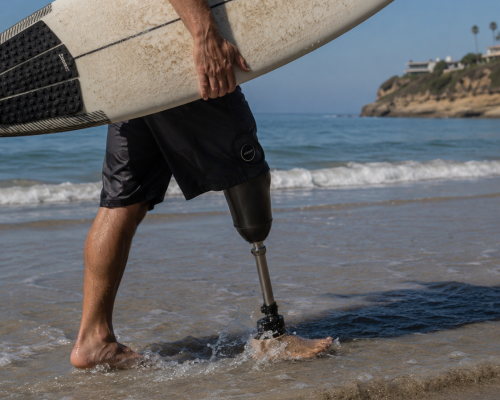
The stages of amputee rehabilitation
Recovery after amputation moves through clear, overlapping stages. We meet you wherever you are in that journey — early after surgery, learning to use a new prosthesis, or returning to long-term goals — and our care evolves with you.
1. Pre-operative & pre-amputation preparation
Where an amputation is planned, early input helps you prepare physically and mentally. We focus on building strength and fitness, explaining what to expect, introducing the rehabilitation pathway, and beginning practice with mobility aids so the transition after surgery is smoother and less daunting.
2. Post-operative & acute recovery
In the early days after surgery, the priorities are safe movement, protecting the residual limb, managing pain and swelling, maintaining joint range, and beginning gentle strengthening. We help you move safely in bed and around the home, start transfers, and prevent the secondary complications — such as contractures and deconditioning — that can slow later progress.
3. Pre-prosthetic rehabilitation
Before a prosthesis can be fitted, the residual limb needs to heal, shrink, and shape, and your body needs to be ready. This stage focuses on oedema (swelling) management and compression, residual limb shaping and desensitisation, scar and wound care, restoring joint range, and building core, trunk, and limb strength. We also progress your balance and mobility with aids, building the foundations for successful prosthetic use — or for confident, independent mobility without a prosthesis.
4. Prosthetic training & gait re-education
Once your prosthesis is fitted, we help you learn to use it confidently and efficiently. For lower limb amputees this means progressive standing balance, weight transfer, and gait re-education — walking smoothly and safely, managing stairs, slopes, and uneven ground, and learning to get up after a fall. For upper limb amputees we focus on functional use of the prosthesis in real, everyday tasks. Throughout this stage we work hand-in-hand with your prosthetist to fine-tune fit, comfort, and alignment as your function improves.
5. Advanced rehabilitation & community reintegration
As your confidence grows, we extend therapy into the activities that matter most to you — returning to work, driving, recreation, sport, and full participation in family and community life. We build endurance, refine higher-level balance and mobility skills, and problem-solve the real-world situations you want to master, in the environments where they actually happen.
6. Long-term management & maintenance
Life after amputation is ongoing, and needs can change over time. We provide review and maintenance support to keep you strong, mobile, and independent, help you adapt as your goals or circumstances shift, monitor residual limb health, and coordinate prosthetic adjustments or replacements with your wider team when required.
Further information & support after limb loss
For trusted information, peer support, and resources before, during, or after amputation, these national organisations are a great place to start. For further information, visit:
- Amputees & limb loss (national peak body, peer support) — Limbs 4 Life (limbs4life.org.au)
- Diabetes-related limb loss & prevention — Diabetes Australia (diabetesaustralia.com.au)
Close collaboration with your prosthetist & health team
Great amputee rehabilitation is a team effort. We work closely and continuously with your prosthetist to align therapy with prosthetic fitting, alignment, and comfort — because the best outcomes happen when therapy and prosthetics progress together. We also collaborate, with your permission, with the wider professionals involved in your care, including:
- Prosthetists — coordinating fitting, alignment, socket comfort, componentry, and ongoing adjustments as your function changes.
- Surgeons and rehabilitation specialists — aligning therapy with surgical and medical management.
- Occupational therapists — supporting daily living, home modifications, equipment, and return to work.
- GPs, wound care nurses, and pain specialists — supporting healing, skin integrity, and pain management.
- Exercise professionals, psychologists, and peer support — supporting fitness, wellbeing, and adjustment.
By keeping communication clear and joined-up across your team, we make sure every part of your rehabilitation pulls in the same direction — toward your goals.
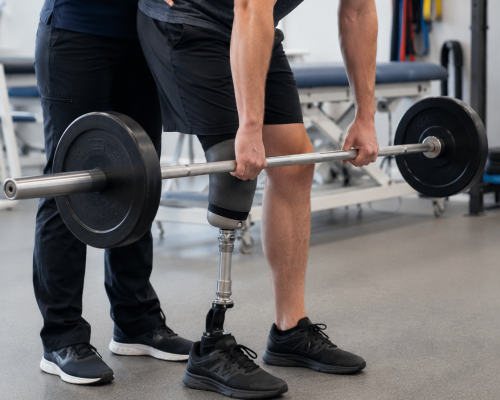
What to expect — information for new participants
Rehabilitation after limb loss takes effort and determination, but you don’t have to do it alone. From your first session we listen, focus on what you can do, and build a plan around the goals that matter to you. Here’s how we work:
- In-home and mobile: we come to you — at home, in the community, at your gym, or wherever your goals happen. No travel, no waiting rooms.
- One-on-one care: you work with the same experienced clinician, with therapy tailored to your stage, abilities, and priorities.
- Clear goals and education: we explain your condition, your options, and each stage of your plan in everyday language.
- Encouragement, not pressure: we’ll challenge you to achieve what’s possible while always respecting your comfort, safety, and limits.
- Group options where suitable: for people with similar goals, supportive group sessions can add motivation and connection.
Our aim is simple: to improve your function, independence, confidence, and quality of life in ways that are meaningful to you.
For support coordinators, case managers & fellow clinicians
Referring a client following amputation or multi-trauma? On Track Rehab makes the process simple, responsive, and collaborative. We provide experienced, mobile physiotherapy and occupational therapy across the Sunshine Coast, Gympie, and surrounding regions, and we work as an extension of your client’s care team. When you refer to us, you can expect:
- Experienced clinicians with a minimum of 20 years’ rehabilitation experience, including complex amputee and multi-trauma caseloads.
- Clear, timely communication about your client’s therapy plan, progress, risks, goals, and support needs.
- A genuinely collaborative approach with prosthetists, support coordinators, case managers, families, carers, GPs, specialists, allied health colleagues, insurers, and funding bodies.
- Practical, results-driven therapy focused on measurable functional outcomes — not generic treatment.
- Timely assessments, clinical updates, progress summaries, and functional capacity reports when required.
- A reliable, easy-to-work-with team that values communication, follow-through, and practical problem-solving.
Whether your client is preparing for surgery, working through pre-prosthetic rehabilitation, or learning to use a new prosthesis, we’re ready to help them get back on track. A fillable referral form is available below.
Funding options
On Track Rehab can see clients under a range of funding models, including NDIS plans, CTP (compulsory third party) claims, NIISQ, icare, the TAC, and private funding. If you’re unsure how your rehabilitation can be funded, get in touch and we’ll help you understand your options.
Areas we service
We deliver mobile neurological rehabilitation across the Sunshine Coast, Gympie, and surrounding regions — from Caloundra, Maroochydore, Buderim, Coolum, and Noosa through to Gympie, Cooloola Cove, Rainbow Beach, and everywhere in between. We meet you where rehabilitation is most meaningful: at home, in the community, at your local gym, or in the places that matter to your daily life.
Ready to get back to what matters most?
Partner with an experienced allied health team who’ll help you move forward. Call 0481 337 987,, email admin@ontrackrehab.com.au, or download our referral form to get started.